Posta Corona
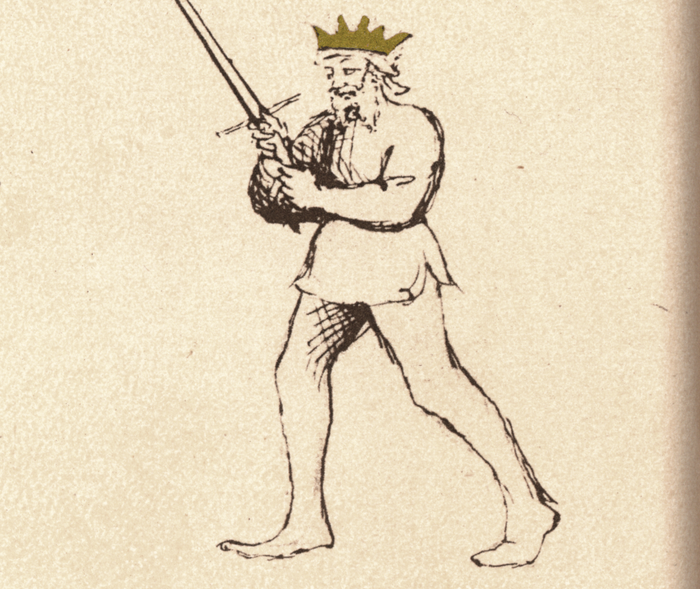
Flos Duellatorum (Pisani-Dossi MS), c. 1409 - Novati facsimile edition, 1902
The Crown Guard
Classification: Instabile — Mutable Guard
Posta Corona is the guard of overhead power. The sword is raised above the head, the arms form a crown-like arc, and the blade is positioned to protect the fencer from above while simultaneously storing energy for the most powerful descending strike in Fiore's system.
For the modern fencer, Posta Corona teaches a principle about the relationship between height and force: the higher the starting point, the longer the arc, and the longer the arc, the greater the momentum. A Fendente delivered from Posta Corona has more time to accelerate than one launched from any other guard. It arrives with a weight and speed that can break through covers and stop opponents mid-commitment.
Posta Corona shares its manuscript verse with Posta Frontale: Fiore presents them as one guard or two names for the same position. This curriculum treats them separately to develop their distinct emphases. Where Frontale focuses on the covering and counterattacking function, Corona focuses on the structural shape of the elevated position and the specific power it generates for descending strikes.
Fiore's Description
Getty Manuscript Text
"Posta frontale, over corona son, che offender e defender voglio. Lo mio parlare a tutti quanti scopro. Che chi me pora zenzer in punta tal conseglio, de ben ferir poy piuy non li scopro."
Translation
"I am the Frontal Guard, or Crown, for I want to offend and defend. I reveal my speech to everyone. For whoever can cross me point to point, such counsel, to strike well after, I reveal to him no more."
The verse applies to both aspects of the guard. Where Frontale's reading emphasizes the deceptive openness and the counterattack triggered by the opponent's commitment, Corona's reading emphasizes the overhead structure and the offensive capability it generates.
"I want to offend and defend": the crown position is explicitly both. The overhead structure defends against incoming high attacks; the position of the sword stores energy for powerful offensive descent.
The Meaning of the Name
Posta Corona means Crown Guard.
The image is visual and precise: the sword held above the head, with the arms slightly spread and elevated, creates the silhouette of a crown. The blade and the arms together form the arcing shape of a crown above the fencer's head.
Fiore uses the crown image to convey both the structural shape and the dignity of the position. The crown is worn at the top. It is the highest expression of the guard family, positioned above all other guards in height. From the crown, one can only descend.
This descent, when it comes, carries everything.
Physical Structure
Body Position
The stance is upright and balanced, with weight neutral or slightly rear-weighted to support the elevated arms.
The body remains tall throughout. Collapsing the torso or allowing the head to drop reduces the arc available for the descending strike and weakens the overhead coverage. The crown sits on the head; the posture must support it.
The fencer should feel tall, grounded in the feet, and ready to drop forward with the sword when the moment comes.
Hand and Sword Position
The hands are elevated above the head, arms extended upward and slightly spread. The sword is held approximately vertical or angled slightly forward, with the point directed upward and forward above the fencer's head.
The arms form the arc of the crown. They should not be rigidly locked, a slight bend in the elbows preserves elasticity and allows the guard to respond to contact without collapsing.
The blade's vertical orientation gives it maximum fall distance. When the Fendente is released from this position, the blade has the longest possible arc it can travel before reaching the target.
The Power of Height
Posta Corona is the highest starting position for a descending strike in Fiore's system.
To understand why this matters, consider the path of a Fendente from different guards:
From Posta Breve, the cut begins near the head and drops through a moderate arc.
From Posta di Donna, the cut begins behind the shoulder and travels a longer diagonal arc.
From Posta Corona, the cut begins directly above the head and falls through the fullest possible vertical-to-diagonal arc.
Each additional foot of starting height gives the blade more distance to accelerate. The Corona Fendente arrives with a momentum that shorter starting positions cannot match. Against a well-held guard, this can make the difference between a strike that is held and one that breaks through.
Fiore describes Posta di Donna as capable of "breaking opposing guards with great blows." Posta Corona generates the same principle with even greater starting height.
The Protective Function
The overhead position of Posta Corona provides natural protection against descending attacks.
Any incoming Fendente directed at the fencer's head must pass through or displace the elevated blade and arms. The crown position creates a structural interference at exactly the height where most descending attacks begin to arrive.
This coverage is not active in the way that Tutta Porta di Ferro beats thrusts to the ground. It is passive: the structure is simply in the path of incoming high attacks. But that structural presence creates the same exchange opportunity that Posta Frontale describes, if the opponent tries to thrust through the high position, that thrust meets the crown and the guard can convert it into a response.
As a Finishing Position for Rising Cuts
Posta Corona is one of the natural finishing positions for the Sottano.
A rising cut launched from Dente di Zenghiaro or Coda Longa travels upward through a diagonal arc. As that arc completes, the blade arrives elevated and the fencer's hands are high, in approximately the Corona position.
This means that Sottano and Corona are connected through a single flowing action:
Low guard → rising cut (Sottano) → Posta Corona → descending cut (Fendente) → low guard
This cycle, rising into high, then falling into low, is one of the fundamental flow sequences of Fiore's system. Posta Corona sits at the apex of this cycle.
The Transition to Posta di Donna
Posta Corona and Posta di Donna are related guards that can flow between each other naturally.
From Corona, a slight rotation of the shoulder chambers the blade behind the right or left shoulder, transitioning into Donna. From Donna, raising the blade directly overhead transitions into Corona.
In practical terms, Corona is often the guard a fencer passes through when moving between the two sides of Donna, a central overhead position from which the blade can drop to either side.
Modern Application
In modern fencing, Posta Corona occupies a role that many practitioners underestimate.
Because its Fendente has the longest arc and highest potential momentum, the Crown guard is the appropriate starting position when a single, decisive overhead strike is needed, against an opponent who has overcommitted, when a break through the guard is required, or when entering with overwhelming force is the tactical goal.
The guard is also pedagogically important as a reference for understanding power generation. Students who practice the Fendente from all starting heights can feel directly how starting height affects the arriving force of the cut. Corona is the clearest demonstration of the principle.
Connection to the Four Virtues
Posta Corona expresses all four virtues in balance, with particular emphasis on the Tiger and the Elephant.
The Elephant provides the stable overhead structure. Holding the arms elevated above the head while remaining grounded requires genuine physical fortitude. The guard should feel strong and supported, not tiring and fragile.
The Tiger governs the speed of the descending release. The Crown guard stores potential energy; the Tiger is responsible for releasing it explosively at the correct moment. A slow release from Corona converts its power advantage into a telegraphed swing.
The Lynx reads when the opponent's commitment makes the descending strike safe and effective. Dropping the Fendente at the wrong moment, before the opponent has committed or after they have already passed, wastes the power the guard has stored.
The Lion holds the elevated position under pressure. An opponent who recognizes the guard and pressures it aggressively is testing the fencer's willingness to remain in an exposed elevated position. The Lion does not flinch.
Defeating the Guard
Posta Corona is most vulnerable to approaches that attack before the descending strike develops.
A fencer who can close distance quickly and enter into close measure before the Crown guard can release its Fendente removes the guard's primary weapon. At very close distance, the overhead sword has no room to descend effectively.
Rising cuts (Sottano) are also specifically effective against the elevated hands. A rising cut launched from below and to the side can strike the hands or arms as they hold the elevated position, disrupting the guard before it releases its strike.
Finally, thrusts directed into the open body below the elevated blade, launched quickly before the descending cut can arrive, can catch the guard while its hands are still high.
What This Guard Is Not For
Posta Corona is not a guard for controlling centerline distance the way Posta Longa does. The elevated blade does not project a direct forward threat; it projects an overhead threat that requires a specific directional response from the opponent.
It is also not a guard for quick, compact actions. The value of Corona is the long arc it enables. Short, fast adjustments at close measure are better served by Posta Breve or Dente di Zenghiaro.
Finally, the guard should not be held statically while fatigued. The elevated position requires muscular endurance, and as the arms tire, the guard degrades into a genuine vulnerability rather than a tactical one. Know when to transition.
Training the Guard
Drill 1 — The Crown Structure
Begin in Posta Corona with the sword raised vertically above the head.
Hold the position for thirty seconds while focusing on: maintaining genuine elevation of the blade, keeping the arms slightly curved rather than rigidly locked, and preserving balance without leaning back.
A partner may apply gentle downward pressure on the blade to test structural integrity. The fencer resists without losing the elevated position.
Repeat three times, increasing endurance gradually.
Drill 2 — The Crown Fendente
From Posta Corona, step forward and release a Fendente.
Allow the blade to travel through its complete arc from above the head down through the target zone, finishing in Dente di Zenghiaro.
Compare the feel of this cut to a Fendente from Posta di Donna. The Corona version should feel heavier and more committed. Repeat ten times.
With a partner: the partner holds a stable guard while the fencer delivers the slow Corona Fendente. The partner observes whether the strike lands with noticeably more arc and momentum than a Donna Fendente.
Drill 3 — Sottano to Corona to Fendente
Begin in Dente di Zenghiaro or Coda Longa.
Deliver a Sottano rising cut, allowing the blade to travel upward and arrive in Posta Corona.
From Corona, immediately release the Fendente back downward, completing the cycle.
Finish in Dente di Zenghiaro and repeat.
Perform ten complete cycles. The three actions, rising cut, pause at corona, descending cut, should feel connected as a single flow rather than three separate strikes. This drill develops the practical use of Corona as the apex of the rising-then-descending cycle.
Common Errors
The most common error is allowing the blade to angle too far forward so it points at the opponent rather than upward. The point should be elevated, directed above the fencer's head, not leveled toward the opponent. The elevated angle is what creates the maximum fall distance for the descending cut.
Another mistake is dropping the arms before releasing the strike. The full arc of the Fendente depends on maintaining elevation until the moment of release. Lowering the hands early shortens the arc and reduces the strike's momentum.
Some students also fail to step with the Fendente, relying on the arm swing alone. The descending cut from Corona, like all Fendenti, requires the coordination of the forward step with the release of the blade.
Key Idea
Posta Corona is the guard of overhead power and stored descent.
The higher the starting point, the longer the arc, and the longer the arc, the greater the arriving force. From the crown of the system, the highest position in the vertical range, the Fendente that descends carries everything the elevation has stored.
The crown is worn above all other positions. And from above all other positions, what falls, falls with the most force.