Dente di Zenghiaro Mezzana
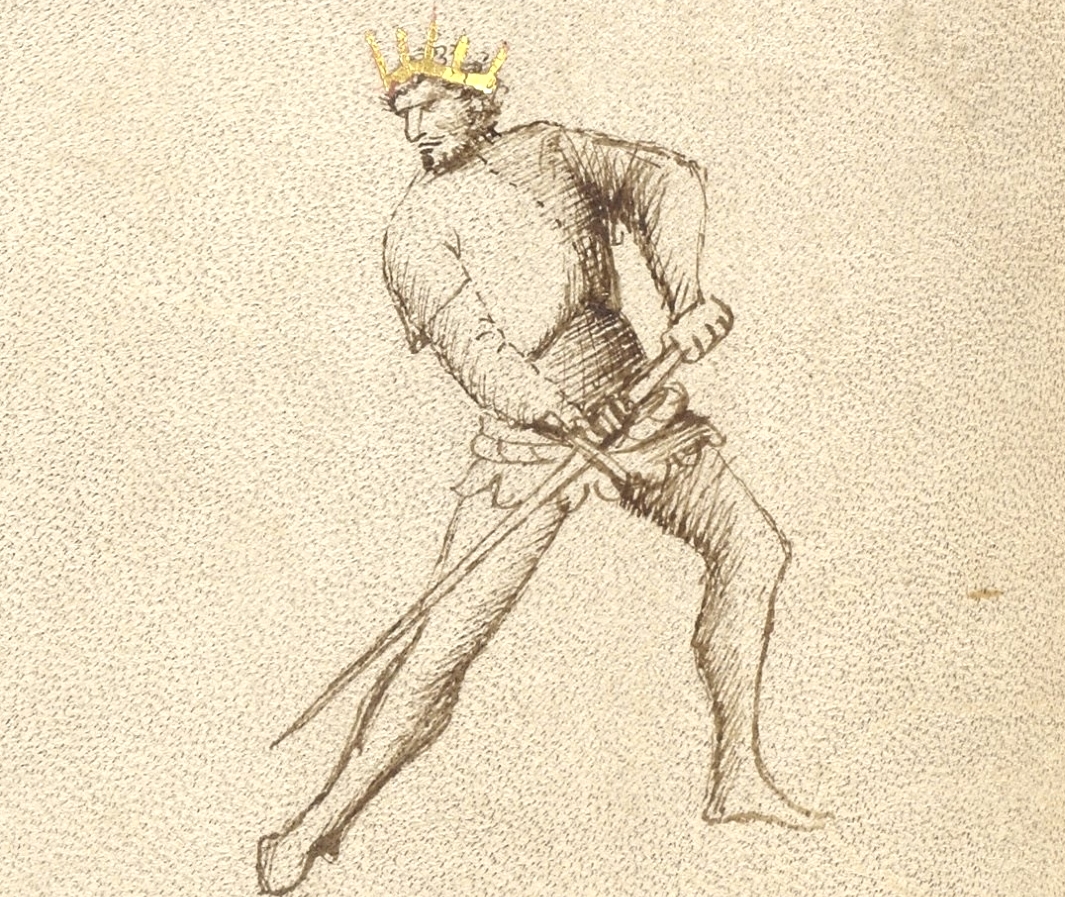
Getty MS Ludwig XV 13, c. 1409 - J. Paul Getty Museum (Open Content)
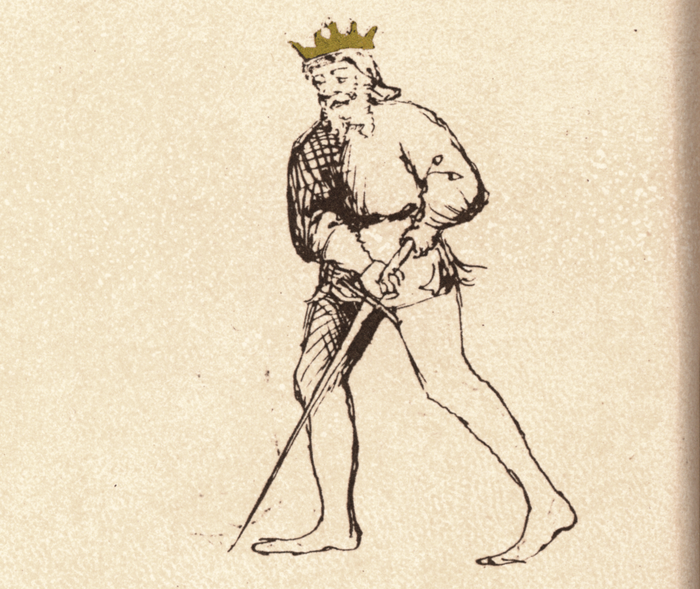
Flos Duellatorum (Pisani-Dossi MS), c. 1409 - Novati facsimile edition, 1902
The Middle Boar's Tooth
Classification: Stabile — Stable Guard
Dente di Zenghiaro Mezzana is the centered expression of the boar's tooth guard family. Where Dente di Zenghiaro Destra and Sinestra angle the sword to one side or the other, Mezzana holds the point on the body's centerline at mid-body height, facing directly forward. The guard occupies the middle position between its two siblings — the tooth that splits the center.
For the modern fencer, Dente di Zenghiaro Mezzana teaches a principle of defensive patience: the guard that faces directly forward, threatening nothing and yielding nothing, can receive any attack on either line and answer it with the same rising defense. It is not a guard of deception or declaration. It is a guard of stillness that contains violence.
Fiore treats the three Dente di Zenghiaro positions as expressions of the same fundamental idea. The Mezzana is the middle of the three, and what either outer tooth can do, the middle tooth can also do.
Fiore's Description
Translation
"This is Posta Dente di Zenghiaro Mezzana, because there are two teeth in the whole boar, and the middle tooth shares the nature of both. What one tooth can do, the other tooth can do, and what the other tooth can do, the middle tooth can do also."
Fiore's description emphasizes continuity and shared capability across the three positions. The Mezzana is not lesser than the outer positions — it contains both of them. A fencer who understands this guard understands the entire boar's tooth family.
The verse also carries a tactical implication: the Mezzana can answer from either line. Attacks to the right fall to the response of the Destra; attacks to the left fall to the response of the Sinestra. From the center, the fencer does not commit to one side before the attack arrives.
The Meaning of the Name
Dente di Zenghiaro means Boar's Tooth, and Mezzana means Middle or Median.
The full name describes the position precisely: the middle tooth of the boar, centered between the two outer teeth. Where Destra places the sword on the right hip and Sinestra places it on the left, Mezzana holds it along the centerline of the body.
The boar's tooth image is about the way the sword rises. A boar does not swing its tusks in horizontal arcs — it drives them upward from below in a sudden, committed thrust. The tooth rises from low to high with the full weight of the animal behind it. The Mezzana expresses this in its most direct form: a rising false-edge cut straight up the center.
Relationship to Dente di Zenghiaro Destra and Sinestra
The three Dente di Zenghiaro guards are a family, not three separate guards.
Destra and Sinestra angle the sword to one side, creating a chamber for the rising sottano from that side. Mezzana holds the center — the point forward, the sword integrated into the body's midline, neither angled left nor right.
In practical use, a fencer moving between guards will often pass through Mezzana as they cross from one side to the other. It is also the natural arrival point for attacks that come directly down the center, where neither the Destra nor Sinestra response is better positioned.
The shared capability Fiore describes means that the Mezzana is not a compromise — it is a complete position that happens to sit at the center.
Physical Structure
Body Position
The stance is rear-weighted, with the weight settled back and the lead foot forward.
The posture remains upright rather than crouched. The weight settling rearward allows the body to drive forward explosively when the rising sottano is launched, converting the stored energy of the rear-weighted stance into forward acceleration.
The guard should feel grounded and calm. There is no angling of the body to either side. The fencer faces the opponent directly with the centerline aligned.
Hand and Sword Position
The hands are held at approximately hip to low-waist height, close to the body.
The sword aligns along the body's centerline with the point projecting forward at mid-body level. Neither the blade nor the grip angles toward either side — this is the distinguishing feature of Mezzana against the outer variants.
The elbows remain connected to the sides of the body, keeping the weapon structurally integrated rather than extended forward like Posta Longa. The point projects forward with enough presence to threaten, but the guard's strength comes from the structural connection of the weapon to the body, not from extension.
The false edge is oriented to face upward, positioning it for the diagonal rising cut that defines the guard's primary attack.
Tactical Function
Dente di Zenghiaro Mezzana operates through defensive patience and explosive rising response.
Holding the center: The forward-facing centerline position gives the guard no obvious left or right commitment. An opponent trying to read the guard finds no angle to exploit. The fencer can answer equally well from either side, and the guard gives away nothing about which response will come.
The rising false-edge sottano: The guard's primary attack is a diagonal rising cut with the false edge — a sottano that travels upward from the low center position toward the opponent's hands, arms, or face. The false edge orientation means the cut rises from below with the back edge leading, creating an unusual angle that many defensive covers are not positioned to handle cleanly.
Defensive interception: Because the point sits on the centerline at mid-body height, it naturally threatens any incoming attack that travels down the center. An opponent charging forward with a direct thrust or descending fendente drives into the guard's point rather than finding an opening beside it. The guard does not need to move to create this threat — it is already in the line.
The False Edge Rising Cut
The defining attack of Dente di Zenghiaro Mezzana is the sottano with the false (back) edge.
From the low centered position, the false edge faces upward. When the fencer launches the rising cut, the blade travels diagonally upward with the back edge leading, arriving at the opponent's hands or arms from below and inside their guard's coverage.
This approach is tactically significant for two reasons.
First, most defensive covers are oriented to receive the true edge. A rising true-edge sottano from below has a predictable line that experienced fencers defend against habitually. The false-edge variant arrives from a slightly different angle and with a different blade orientation, requiring a distinct defensive response that many fencers have not drilled as thoroughly.
Second, the false edge cut from the centered position travels up the middle — not from either side, but straight through the center. Against an opponent whose guard protects either side without covering the direct middle line, the Mezzana's central path finds the gap between those protections.
Modern Application
In modern fencing, Dente di Zenghiaro Mezzana is the most statically threatening of the boar's tooth positions.
A fencer who holds the Mezzana against an aggressive opponent presents no commitment to either side, no false opening to exploit, and a direct forward threat that must be respected. Opponents who advance carelessly into the forward point without addressing it find the exchange happens on the Mezzana fencer's terms.
The guard is also useful as a resting position in the middle of a flow. After a descending fendente that clears one side, the fencer can settle momentarily into Mezzana before the next commitment, taking stock of the exchange without leaving an obvious opening.
For students building guard fluency, the Mezzana provides a useful reference point: it is the neutral version of the boar's tooth family, and the transitions from Mezzana to Destra and Sinestra teach the fundamental mechanics of chambering and releasing the rising cut from both sides.
Connection to the Four Virtues
Dente di Zenghiaro Mezzana expresses the Elephant most fully.
The centered, rear-weighted stance with the point forward creates structural stability that is difficult to displace. The guard does not reach toward the opponent; it holds the line and waits. This quality of settled, patient solidity is the Elephant's fortitude expressed as posture.
The Tiger governs the explosive release of the rising sottano. The rear-weighted stance stores energy; the Tiger converts it into sudden forward acceleration when the moment arrives.
The Lynx reads the opponent's line and decides whether the response is the Mezzana's own central rising cut or a shift into the angled response of Destra or Sinestra. The decision must be made as the attack develops, not after it has arrived.
The Lion holds the exposed centerline position. Facing the opponent directly without angling away requires the courage to present oneself honestly to incoming attacks.
Defeating the Guard
Dente di Zenghiaro Mezzana is most vulnerable to attacks that change angle before arriving.
Because the guard holds the center and the false-edge sottano rises through the middle, a committed attack that begins centrally but angles to one side before contact can find the space beside the point rather than running into it.
Indirect approaches — feints that draw the guard's rising response, then redirect into the opening created — also challenge the Mezzana. If the fencer releases the rising cut too early against a feint, the guard is momentarily depleted and the opponent can exploit the recovery.
At very close measure, the low and compact position leaves the head and upper body without the overhead coverage that guards like Bicorno or Posta Frontale provide. An opponent who collapses distance suddenly and drives forward high can find the guard unprepared for the transition to narrow play.
What This Guard Is Not For
Dente di Zenghiaro Mezzana is not a guard for controlling long measure. Its point threatens the mid-body line, not the extended forward space that Posta Longa commands. An opponent at long measure who advances carefully will not be threatened by the guard's forward point until they have already closed to mid range.
It is also not a guard for deception. Unlike Coda Longa, which hides its sword behind the body to disguise intent, Mezzana presents the sword forward and honestly. Its tactical advantage comes from the false-edge cut's unusual angle, not from deceiving the opponent about the position of the blade.
Finally, the guard should not become passive waiting. The settled quality of Mezzana is a readiness to respond, not an absence of threat. The point must remain present and credible, and the fencer must remain genuinely prepared to launch the rising cut rather than simply standing in the position.
Training the Guard
Drill 1 — Establishing the Mezzana Center
Begin in Dente di Zenghiaro Destra. Transition smoothly to Mezzana by bringing the sword from the right hip to the body's centerline, the point continuing to project forward at mid-body height.
Hold the Mezzana position for fifteen seconds while a partner slowly circles at mid range.
The partner attempts to read which side the rising cut will come from. The fencer does not telegraph any commitment. The point should feel genuinely neutral — capable of rising from either side equally.
Repeat from the Sinestra side, then practice transitioning Destra → Mezzana → Sinestra as a single fluid flow.
Drill 2 — The Central Rising Sottano
From Dente di Zenghiaro Mezzana, launch a false-edge rising sottano directly up the center.
The false edge leads. The blade travels diagonally upward from the low center, the back edge arriving first toward the partner's extended hand or forearm.
Focus on the path of the blade: it should rise through the centerline, not curve to either side. Repeat ten times.
With a partner: the partner extends a hand at approximately waist height as a target. The Mezzana fencer rises the sottano so the false edge arrives at the underside of the partner's hand. Neither fencer should contact with force — the drill establishes the correct line and angle of the rising cut.
Drill 3 — Defensive Interception
One fencer holds Dente di Zenghiaro Mezzana. The partner delivers a slow, direct descending fendente aimed at the Mezzana fencer's head.
The Mezzana fencer does not move — the forward point simply receives the incoming blade as the descending cut drives into the guard's structure.
After the contact, the Mezzana fencer steps forward and delivers the rising sottano as a counter.
The lesson: the guard's centered forward point intercepts direct attacks without active deflection. The fencer does not need to block the incoming strike — the position has already occupied the line.
Common Errors
The most common mistake is allowing the sword to drift off the centerline, angling to one side. Mezzana is defined by its centered position. Any drift toward Destra or Sinestra changes the tactical character of the guard and loses the central threat.
Another error is pointing the false edge incorrectly. The back edge must face upward to allow the rising false-edge cut. Rotating the sword so the true edge faces upward converts the guard into a different position and removes the distinctive false-edge angle of the Mezzana's primary attack.
Some students also allow the stance to become front-weighted, removing the explosive launching potential of the rear-weighted chamber. The guard must feel loaded — the weight back, ready to drive forward — not settled passively on the front foot.
Finally, holding the guard with a rigid, extended point that does not threaten credibly undermines its defensive value. The point must sit forward with genuine presence, close enough to body structure to be supported, far enough forward to require the opponent's attention.
Key Idea
Dente di Zenghiaro Mezzana is the guard of the patient center.
It holds the middle, commits to neither side, and carries the same rising tooth that its siblings carry — available from any angle, threatening from no particular direction until the moment it is no longer patient.
What one tooth can do, the middle tooth can also do. But only the middle tooth can wait without choosing.