Fendente Sinestra
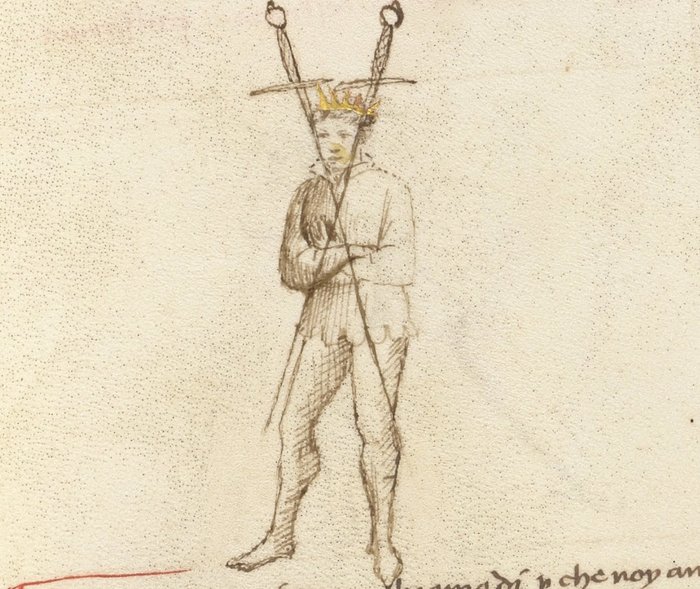
Getty MS Ludwig XV 13, folio 23r, c. 1409, "We are descending blows and we advance; we break teeth with good intention." J. Paul Getty Museum (Open Content)
The Descending Cut from the Left
Fendente Sinestra is the second of Fiore's seven blows. It is a descending diagonal cut delivered from the left side, the mirror image of Fendente Destra in both mechanics and tactical purpose.
For the modern fencer, the Fendente Sinestra teaches a principle that the right-side cut alone cannot: a fencer who can descend from both sides controls two lines simultaneously. The left-side cut is not simply a backup to the dominant hand: it is a distinct attack that forces the opponent to defend a different angle entirely.
Fiore's system is built around bilateral movement. The Fendente Sinestra is the first expression of this principle in the strikes.
Physical Description
Path of the Blade
The Fendente Sinestra begins high on the left side, most commonly from Posta di Donna Sinestra.
From this position, the blade travels diagonally downward at roughly a forty-five degree angle, cutting from the left shoulder toward the opponent's right side. The strike may land on the head, right shoulder, arm, or continue through toward the torso.
The path is a direct mirror of the Fendente Destra. The acceleration and arc are identical in quality, though reversed in direction.
Body Mechanics
The cut is typically delivered with a forward step of the left foot.
As the step occurs, the hips rotate to the right, followed by the shoulders and arms. The weight shifts forward, driving the body into the cut. The motion is a complete bilateral reversal of the right-side fendente, the same coordinated structure, the same hip-led drive, the same follow-through.
Students who have trained the right-side cut extensively will often find the left feels mechanical or underpowered at first. This is normal. The mechanics are identical; only the habit is lacking.
Ending Position
The Fendente Sinestra most commonly finishes in Dente di Zenghiaro Sinestra, a low guard with the point forward on the left side.
It may also finish in Porta di Ferro Mezzana, depending on the height and intent of the strike. In either case, the blade ends low with structure intact, prepared for the next action.
Tactical Function
The primary value of the Fendente Sinestra is that it attacks the opponent's right side, a line that is typically less guarded than the left.
Because most guards and defensive habits are built around protecting the left-center line, a well-timed descending cut from the left can find openings that the right-side cut cannot. The opponent must actively reorganize their defense to cover the right, and that reorganization creates vulnerabilities elsewhere.
Fiore's system uses this not as a separate strategy but as a continuous pressure. By threatening both descending lines, the fencer forces the opponent into an impossible defensive equation: covering the left exposes the right, and covering the right exposes the left.
Modern Application
In modern fencing, the left-side fendente is often underdeveloped. Because most training begins on the dominant (right) side, the Fendente Sinestra tends to feel slower, weaker, and less natural.
This is a training problem, not a mechanical one.
The solution is deliberate bilateral practice: equal repetitions on both sides until the left cut matches the right in structure, speed, and commitment. A fencer who can deliver a credible fendente from both sides has meaningfully doubled their attacking options.
In sparring, the Fendente Sinestra is most effective when used in combination with the Fendente Destra. Alternating sides prevents the opponent from settling into a defensive pattern and often produces openings that neither cut would create alone.
Connection to Guards
Primary Starting Guards
The most natural starting position is Posta di Donna Sinestra, where the blade is already chambered over the left shoulder.
It may also be delivered from Posta Breve for a quicker, more compact version, or transitioning fluidly from a right-side action when the opponent's defense shifts.
Ending Guards
The strike most often concludes in Dente di Zenghiaro Sinestra, providing a strong low position for continuation on the left side.
From there, the fencer may transition naturally back to the right side or continue with a rising action.
Connection to the Four Virtues
The Fendente Sinestra reflects the same four virtues as the right-side cut, with one additional emphasis.
The Lion demands equal commitment on both sides. A left-side cut delivered with hesitation carries no tactical value. It must be launched with the same intent as the Fendente Destra.
The Tiger requires that the left side match the right in speed. A slow left cut telegraphs itself and provides no surprise.
The Elephant maintains structure through the reversal. The body mechanics on the left side must be as stable and connected as on the right.
The Lynx governs the moment of transition, reading when the opponent has committed to defending the right and the left line has opened.
Common Tactics
The Fendente Sinestra is most effective when used in alternating combination with Fendente Destra. A right-side cut followed immediately by a left-side cut attacks from two angles in rapid succession, preventing the opponent from recovering between actions.
It may also be used as a primary attack when the opponent's guard or footwork leaves their right side exposed. Because the left cut is less expected, it can sometimes succeed where the right would be anticipated.
Like the Fendente Destra, the left-side cut is effective as a structure-breaking attack. Delivered with full commitment into the opponent's blade, it can displace their weapon and create immediate follow-up opportunities.
What This Cut Is Not For
The Fendente Sinestra is not a substitute for developing the right-side cut. Both must be trained to equal proficiency; compensating for a weak left side by relying exclusively on the right creates a predictable pattern.
It is also not effective as a tentative or uncommitted action. A half-committed left cut provides neither tactical pressure nor structural force.
Finally, like all descending cuts, the Fendente Sinestra is not suited to very close distance. At measure too short for the arc to develop, smaller and more direct actions are required.
Training the Cut
Drill 1 — Bilateral Development
Begin in Posta di Donna Destra and deliver a Fendente Destra, finishing in Dente di Zenghiaro.
Flow from Zenghiaro into Posta di Donna Sinestra, then deliver the Fendente Sinestra, finishing in Dente di Zenghiaro Sinestra.
Return to Donna Destra and repeat.
Perform ten complete cycles, twenty cuts total. Focus on matching the structure, speed, and follow-through of both sides. The left should feel like the right before the drill is finished.
Drill 2 — Alternating Sides with a Partner
One fencer delivers the Fendente Destra toward the partner's left side, then flows immediately to the left and delivers the Fendente Sinestra toward the partner's right side.
The partner observes the path of both cuts, noting which line arrives more cleanly and why.
Repeat ten times, then switch roles.
The goal is not speed but accuracy and quality. Both cuts should arrive with the same structure and intent.
Common Errors
The most common problem is a weaker or slower left cut. This is a habit, not a physical limitation. Equal practice on both sides corrects it over time.
Another common error is different mechanics on the two sides. The body tends to compensate on the non-dominant side by using the arms more and the hips less. Film or mirror work helps identify this. The mechanics must be identical.
Some students also fail to commit fully on the left side. The left cut should be delivered with the same intent as the right, any hesitation reduces its effectiveness.
Key Idea
The Fendente Sinestra is not simply the Fendente Destra performed on the other side.
It is a separate attack that controls a different line, creates different pressure, and demands a different defensive response from the opponent.
When both cuts are equally developed, the fencer does not fight on one side: they fight across the full width of the opponent.