Exchange of Thrusts — Scambiar di Punta
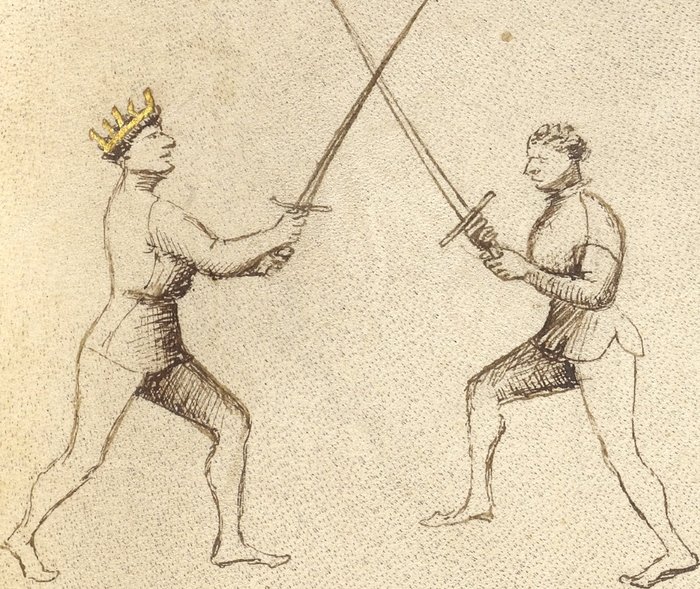
Getty MS Ludwig XV 13, folio 25r, c. 1409 - J. Paul Getty Museum (Open Content)
The Exchange of Points
Classification: Gioco Largo — Wide Play
The scambiar di punta is the most direct counter to a thrust. When the opponent advances with a point aimed at your face or chest, you do not retreat. You do not block and then counter. You step offline and thrust simultaneously, a single motion that removes your target and creates your own.
Step out of the attack, not into it. The same movement that removes your target creates your own.
The name carries a deliberate pun. Punta means both thrust and point. The exchange is not simply an exchange of thrusts: it is an exchange of points, in which your point replaces theirs.
Fiore's Description
Getty Manuscript Text
"Questo zogho si chiama scambiar di punta e fa si in questo modo: como lo compagno te vene cum una punta, tu gli va fora de strada cum lo pè dinançi, e poy passa anche fora de strada cum l'altro pè, e cum le braze, incrosa la sua spada, e la tua punta va in lo volto overo in lo petto."
Translation
"This play is called exchange of thrusts, and is done in this way: as your companion comes at you with a thrust, you step out of line with your front foot, and then also step off the line with your other foot, and with your arms, cross his sword, and your point goes into his face or his chest."
Notice that Fiore gives the footwork first.
The step is not a preparation for the counter-thrust. The step and the thrust are the same action.
The Setup
The opponent advances with a thrust aimed at your face or chest.
You are in wide play, blades have not yet crossed, or have just made contact at the point.
The threat is direct and committed.
The Technique
The action has three components that happen as one motion:
Step offline with the front foot. Move the leading foot out of the line of attack, forward and to the outside, approximately forty-five degrees off the original line. This removes you from the path of the thrust.
Pass the rear foot to follow. The back foot steps obliquely across, completing the offline movement and bringing the body fully out of line. This is not a retreat. You are moving forward and off the line simultaneously.
Cross his sword with your arms extended low. As your feet move, your arms extend outward and downward. The goal is to collect the incoming blade, not block it, but redirect it past you. Your arms go low and wide. This controls his point without stopping your own motion.
Drive your point into his face. While your arms collect his blade low, your sword's point is already angling upward toward his face. By the time the crossing is complete, your thrust has arrived.
These are not four steps. They are one motion in four directions.
Why It Works
The scambiar di punta works because it solves two problems simultaneously.
The opponent's thrust is a threat to a specific location: where you were standing. The offline step removes you from that location. His thrust arrives where you are no longer.
At the same moment, your arms extend to collect his blade. His weapon is redirected past you at the low line. Even if he committed fully, his point cannot find you.
Your point, meanwhile, has been driving toward him throughout. He has not moved offline. He is still where he was.
The geometry is simple: you are no longer where he is thrusting, and your point is where he still stands.
The Counter-Remedy
A skilled opponent can defeat the scambiar.
If he anticipates your offline step, or if he maintains control of his blade as you collect it, he can beat your counterthrust aside before it arrives.
When this happens, your right foot has likely passed forward in the course of the action. That means stretto is now available.
The exchange of thrusts, when it succeeds, ends the exchange. When it fails, it becomes the entry into narrow play. Either outcome has a continuation.
Connection to the System
The scambiar di punta flows most naturally from guards that already prepare the body for an offline passing step.
Posta di Donna Destra positions the sword behind the shoulder and the body turned slightly, ready to pass offline with the rear foot.
Tutta Porta di Ferro, the Full Iron Gate, generates the exchange directly. Fiore associates Tutta Porta di Ferro with the exchange of thrusts, describing the guard's action of entering with a cover and thrusting.
The play also connects forward: if the exchange succeeds, the opponent is struck. If the opponent counters and your right foot is now forward, the pommel strike and close-play entries are immediately available.
Modern Application
For the modern fencer, the scambiar di punta is the most directly competition-relevant play in Fiore's entire system.
The reason is structural. Most HEMA scoring systems reward clean hits to open targets. A counterthrust that lands while your own target has moved offline is exactly this: your opponent's weapon arrives at empty space while yours arrives on target.
The technique also trains a principle that applies regardless of ruleset or weapon: when someone commits to a thrust, the correct answer is usually not to intercept it but to not be there.
In practice, the single-tempo execution, step and thrust as one motion, is what competitors find most difficult to achieve and most valuable when they do. Train it until the step and the thrust feel like the same impulse, not two separate decisions.
Connection to the Four Virtues
The scambiar di punta expresses all four virtues, but primarily two.
The Tiger governs the speed of the action. The exchange of thrusts is a single-tempo counter, it must be fast enough that your point arrives before the opponent can recover or adjust. A slow scambiar is not a scambiar.
The Lynx governs the timing. You must read the opponent's thrust as it begins, not after it has fully committed. The step offline must happen early enough to clear the line of attack.
The Lion appears in the commitment to the counterthrust. The arm extends, the point drives forward. There is no half-measure here.
The Elephant provides the structure that keeps the body stable while moving offline. The footwork changes your position, but your sword arm must remain controlled throughout.
What This Play Is Not For
The scambiar di punta is not a defense against a cut.
A descending strike travels along a wide arc. The offline step that removes you from a thrust does not necessarily remove you from a cut that follows the same arc. Do not attempt to exchange the thrust against an attack that begins as a cut.
It is also not a blocking technique. The arm extension is a collecting motion, it redirects the incoming blade, not stops it. Attempting to block with force defeats the geometry of the play.
Finally, it is not a two-step action. Stepping offline and then thrusting is slower, more telegraphed, and easier to counter. If you find yourself pausing between the step and the thrust, the technique is not yet trained.
Training the Play
Drill 1 — Solo Offline Stepping
Step forward and offline at forty-five degrees with the front foot, then pass the rear foot to follow.
Practice until the two steps feel like one motion, not two.
Add the arm extension: as you step, extend both arms outward and downward as if collecting a blade that isn't there.
Repeat from both sides.
Focus: The step and extension are simultaneous. The body arrives offline before the feet stop moving.
Drill 2 — Slow Partner Thrust
Partner A presents a slow, committed thrust aimed at Partner B's face.
Partner B performs the scambiar at half speed: step offline with front foot, pass rear foot, collect Partner A's blade low, extend point toward Partner A's face.
Both partners pause at the completion to verify:
- Is Partner B fully offline?
- Is Partner A's blade collected and redirected low?
- Is Partner B's point aimed at Partner A's face?
Switch roles. Repeat.
Focus: Correct geometry at completion. Do not yet worry about speed.
Drill 3 — Live Threshold
Partner A commits to a thrust at their own comfortable pace.
Partner B performs the scambiar at full speed, aiming to have the point on target before Partner A can recover.
Begin slowly and increase speed as the geometry becomes reliable.
Focus: The step and thrust arriving simultaneously. Partner B should not be hit, and Partner A should be touched. If either fencer is hit unexpectedly, slow down and identify what broke.
Common Errors
A common mistake is executing the offline step and the thrust as two separate actions. The footwork happens first, then the thrust follows. This makes the play slower and gives the opponent time to adjust. The step and the thrust are one motion.
Another error is stepping offline at too shallow an angle. A slight lean to the side does not remove you from the line of attack. The step must genuinely clear the path of the incoming weapon.
Many students keep their arms too high as they collect the incoming blade. The arms should extend low and outward, this redirects the opponent's thrust past you at the low line. Arms at chest height do not collect the thrust, they meet it.
Finally, some students stop moving once the crossing is made, rather than driving the point through to the target. The play does not end at the crossing. It ends at the touch.
Key Idea
The scambiar di punta is not a parry followed by a thrust.
It is a single action in which stepping offline and thrusting are the same impulse.
The opponent's point arrives at empty space. Yours arrives at a target that has not moved.
Step out of the line. Drive the point home. These happen together, or not at all.